Schumacher wallpaper
Calculator Logic
This is the same calculation we use on every install. It has worked on every job. We have never miscalculated a job in over 15 years. The math is precise. It does not pad the quantity the way many online calculators do. If you want extra material for the installer, that is your choice. It is not hidden in the number.
The pictures below are one example. How many strips you need, how the pattern repeat lands, and how many strips come off a roll all change with that wallpaper's width, length, and pattern. On every product page those three are already filled in. You enter the wall.
How many strips
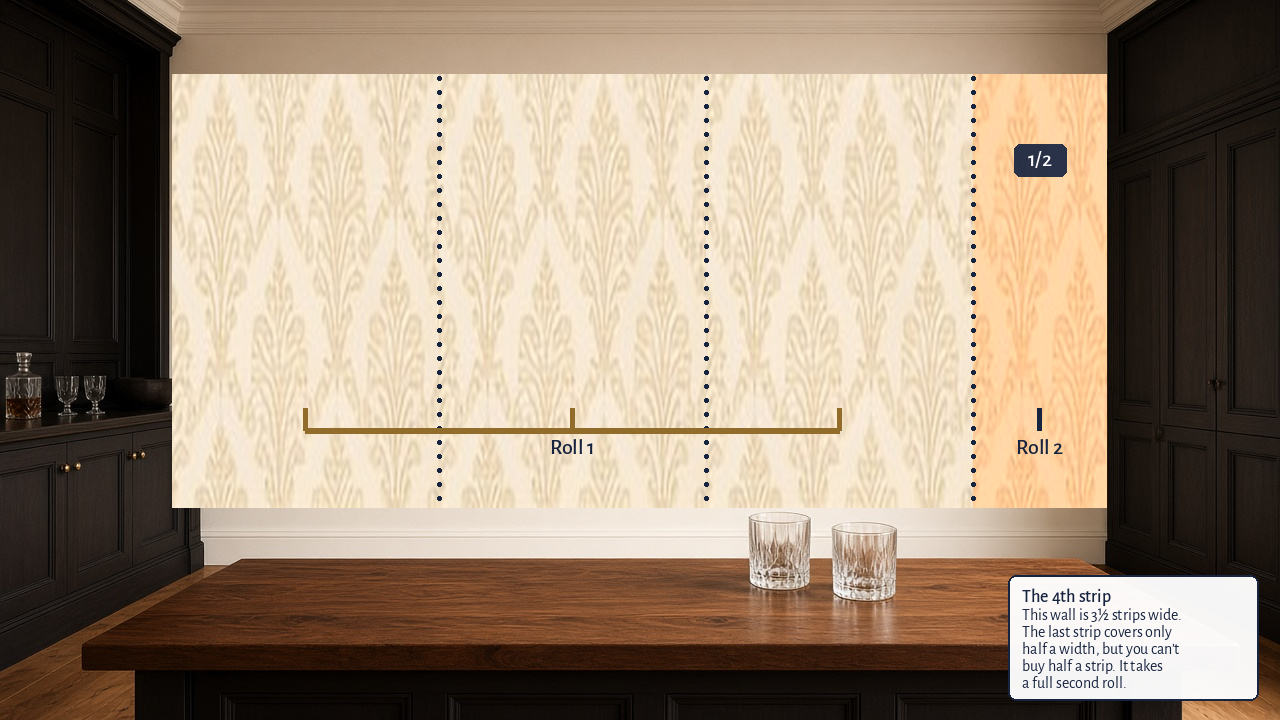
The wall's length is divided by the wallpaper's width. Anything left over still counts as a whole strip. You can't buy part of a strip.
In this picture the wall is 3½ strips wide, so it takes 4 strips. Roll 1 is the three full strips that fit on one roll. The fourth strip only covers half a width, but it is a full second roll.
Pattern repeat
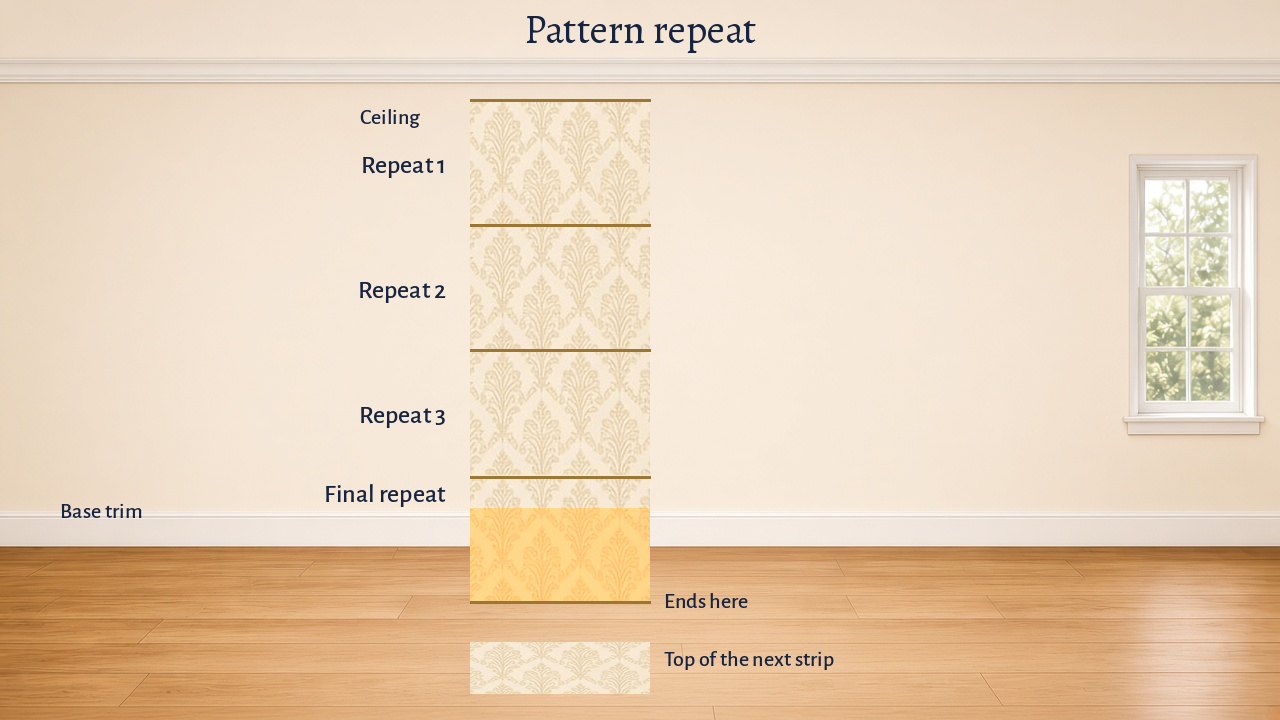
Each strip starts as the wall height plus 4 inches. That 4 inches is one trim allowance for the strip, not 4 inches at the top and another 4 at the bottom.
If the pattern has a vertical repeat, the strip is then lengthened to the next full repeat. That extra length is on every strip, which is how we know how many strips come out of one roll. The last repeat in this picture is mostly past the base trim. The piece after the gap is the top of the next strip.
Strips per roll
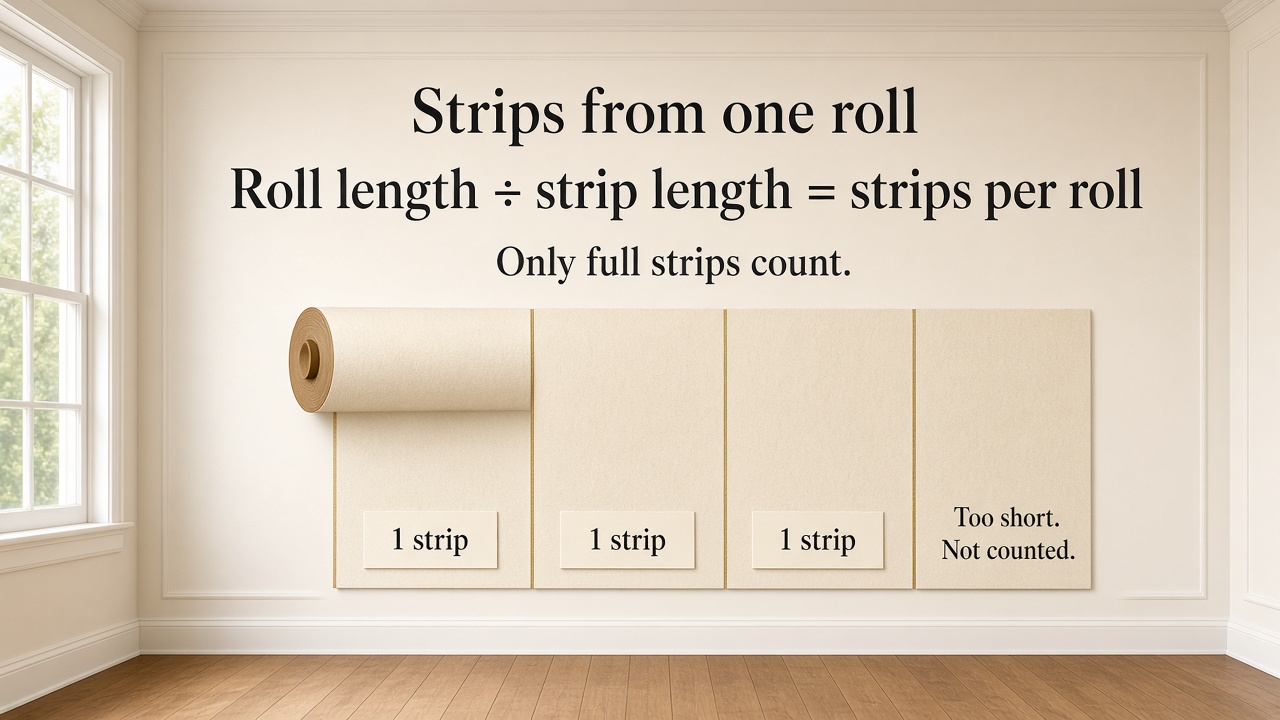
Roll length divided by that strip length is how many strips one roll gives you. Anything left on the roll that is shorter than one full strip is not counted. A double roll is one continuous bolt, so the full bolt length is what gets divided.
What you order
The strips are turned into yards, and the yards round up. The quantity you can order then follows how that wallpaper is sold: the mill's minimum and the step it sells in. Nothing extra is added.
Borders and trims are not part of this calculator.